As a teacher, I am always a little nervous when I have to email a parent about a concern at school. I never know how the message will be received. Some parents are grateful for the communication, while others are understandably upset or worried.
Now that I'm a mother myself, I understand those emotions much better. Even a small comment about our children can feel personal. So when a teacher tells you that your child is struggling academically or behaviorally, it can be hard not to imagine the worst.
The good news is that most of the time, a teacher's email is not a sign that something is seriously wrong. More often, it is an invitation to work together.
In this article, I'll give you an inside look at what teachers are really thinking when they reach out to parents. I'll also share practical strategies you can use at home to help your child succeed at school.
Table of Contents
If you've just received an email from your child's teacher saying they are struggling in school, take a deep breath.
I know that's easier said than done. As parents, we love our children deeply, and it can be painful to hear that they are having a hard time academically, socially, or behaviorally. It's natural to feel worried, defensive, embarrassed, or even frustrated.
My first piece of advice is simple: don't panic.
Very few problems in education are emergencies. Most of the time, a teacher is reaching out because they want to work with you before a small concern becomes a bigger one. In fact, the email itself is often a positive sign—it means the teacher cares enough to communicate and is looking for ways to help your child succeed.
If the email makes you emotional, give yourself some time before responding. Read it, step away, and come back to it later. Sometimes a message can feel much more alarming in the moment than it does the next day.
It's also important to remember that email is not always the best form of communication. A teacher may write a short message simply because they are trying to communicate quickly, but without hearing someone's tone of voice, it's easy to misunderstand their intentions.
If you're feeling confused or concerned, don't be afraid to ask for more information. A phone call or face-to-face conversation can provide valuable context and help you better understand what is happening at school.
When we don't have all the information, our minds tend to fill in the gaps. We imagine worst-case scenarios. We wonder if our child is falling behind academically, if they have a learning disability, or if something bigger is wrong. Most of the time, those fears are much larger than the actual problem.
Before you assume the worst, gather information. Ask questions. Listen carefully. Once you understand the concern clearly, you and the teacher can work together to create a plan that helps your child move forward with confidence.
One of the most common reasons teachers contact parents is because a child is having difficulty focusing in class.
Before you panic, I want to reassure you of something: this is incredibly normal.
Teachers are responsible for many students at once, each with different personalities, strengths, interests, and challenges. A child doesn't have to be "bad" for their behavior to become a concern. Sometimes a student is simply making choices that are making it harder for themselves—or their classmates—to learn.
In many cases, the teacher is not looking for a diagnosis or suggesting that something is seriously wrong. They are simply asking for your support.
I remember one student who started making funny noises during carpet time while I was teaching. It wasn't severe behavior, but it was becoming a habit and was making it difficult for the class to stay focused. I sent a quick email home asking if the parents could speak with him about it.
In my mind, it was a small concern. Young children do silly things all the time, especially when they are tired, excited, or seeking attention.
I was surprised by how worried the parents became. They immediately wanted to meet, and during our conversation they asked if I thought their child might have ADHD.
The truth is that most classroom behaviors do not automatically point to a diagnosis. Children are still learning self-control, attention skills, and appropriate classroom behavior. Sometimes they simply need a reminder, extra support, or more opportunities to practice.
If your child's teacher reaches out about behavior or focus, try not to jump to worst-case conclusions. Instead, ask questions.
Often, a simple conversation at home can make a big difference. When children know that their parents and teachers are working together, they are much more likely to take the concern seriously.
Sometimes all a child needs is a gentle reminder:
"Your teacher is trying to help you learn. Let's work together to make sure you're listening and doing your best."
That small message can go a long way.
If your child's teacher tells you that they are behind academically, it can feel scary. As parents, we want our children to succeed, and it can be difficult to hear that they are struggling with reading, writing, math, or another subject.
The first thing I want you to know is this:
Being behind does not mean there is something wrong with your child.
Children learn at different rates and have different strengths. In every classroom I have taught, there have been students who seemed to pick up reading effortlessly, while others needed much more practice and support. I've taught children who excelled in math but struggled socially, and children who were incredible artists but found writing difficult.
Every child develops differently.
One of the beautiful things about teaching is seeing how unique each student is. Some children are natural readers. Some are builders. Some are athletes. Some are leaders. Some are incredibly creative. Every child brings different gifts to the classroom.
In fact, I've often noticed that students with exceptional strengths in one area sometimes need extra support in another. That's completely normal.
It's also important to remember that school is supposed to be challenging.
Learning new skills requires effort, mistakes, and perseverance. If your child finds something difficult, that doesn't necessarily mean they are failing. It often means they are learning.
When a teacher reaches out about academic concerns, they are usually not trying to tell you that your child cannot succeed. More often, they are identifying an area where a little extra support could make a big difference.
As teachers, we do our best to meet the needs of every learner, but there are only so many hours in a school day. Sometimes a few minutes of one-on-one practice at home can accelerate a child's progress dramatically.
Instead of asking:
"What's wrong with my child?"
Try asking:
"What skill is my child struggling with, and how can we help them improve?"
That small shift in perspective can change everything.
Your child doesn't need to be perfect. They simply need support, encouragement, and opportunities to practice. And as their parent, you are one of the most powerful influences in their learning journey.
So my first piece of advise is to not freak out. Nothing good comes from getting upset, or crying about something you don't fully understand. You can take a day to sit on it too. If the email makes you angry or emotional, I recommend waiting a day to respond. Sometimes when you read the email the next day, you can see that it's really not that bad.
In my experience, email is really not the best form of communication when speaking to parents about their child. Unfortunately, that is sometimes the only means of communication that I have with some of my parents. An email might mean one thing to the sender and another to the receiver of the message. If the message is painful to read, I would advise you to get more information on what is going on- ideally over the phone or in person. This allows you to hear each others tone of voice or see the body language of the other person. The teacher can give you a better picture of the concern, once they are able to speak a little more freely, and not through the keyboard.
Sometimes our fears and anxieties come from not having all the information. Where there are gaps, our brains like to fill them in with stories we make up. We imagine the worst case scenario. Make sure you follow up with the teacher and get the information you need to understand what is really going on. This will help you to feel calmer about the situation and gives you the tools you need to come up with a plan for your childs' school success.
Once you understand what your child is struggling with, it's time to make a plan.
One mistake I see parents make is trying to solve a problem that is too vague.
For example:
"My child needs to read better."
That's not actually a goal. Reading is made up of many different skills, and it's difficult to help your child if you don't know which skill is causing the problem.
Instead, try to identify the specific area where your child needs support.
For example:
Notice how much clearer those goals are.
The more specific the goal, the easier it becomes to help your child make progress.
If you're unsure what the problem is, ask the teacher for clarification. Don't be afraid to ask questions like:
Most teachers will be happy to provide examples and suggestions.
Once you know exactly what your child needs to work on, choose one goal and focus on it consistently. Small improvements made over time often lead to the biggest results.
Remember: your goal is not to fix everything at once. Your goal is to help your child take the next step forward.
Progress is built one skill at a time.
Once you know exactly what skill your child is struggling with, ask the teacher what you can do at home to support them.
Many schools have moved away from traditional homework, but that doesn't mean there aren't ways to practice important skills outside of school.
Let the teacher know that you want to help. Ask if there are activities, games, books, or exercises they recommend. Don't leave the conversation without a few practical next steps.
The key is consistency.
Ten minutes of focused practice a few times a week is often more effective than a long homework session once in a while.
For example, if your child is working on sight words, you might decide that every evening after dinner you will spend five or ten minutes practicing together.
At first, there may be a little resistance. That's normal. Most new routines take time to become habits.
Try to make the experience positive. Read together on the couch. Build a blanket fort and practice inside. Use silly voices. Turn it into a game.
Remember, your goal is not just to improve a school skill. You're also teaching your child an important life lesson:
When something is difficult, we don't give up. We practice.
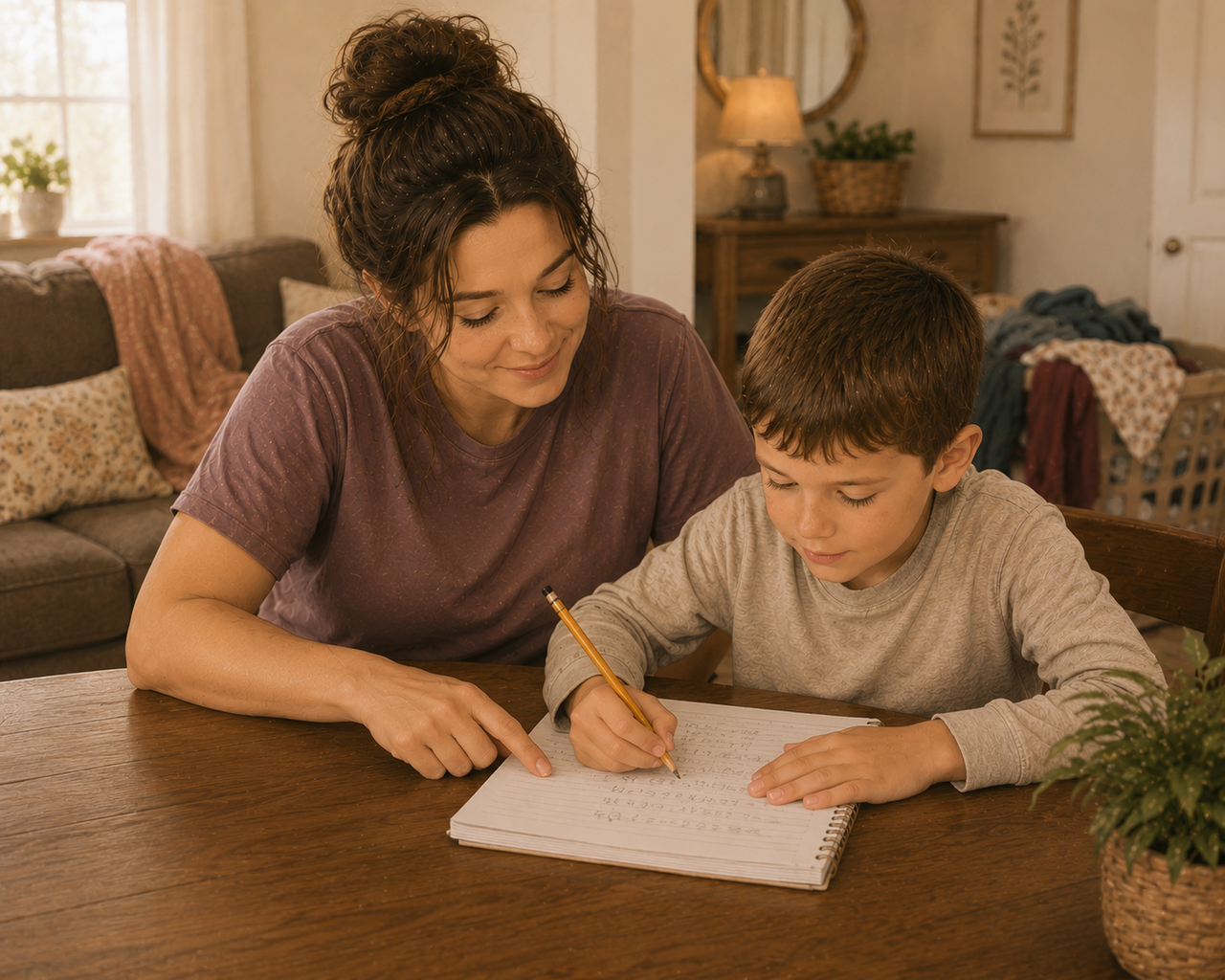
One of the unexpected benefits of helping your child at home is that it creates opportunities to connect with them. Some of my favorite childhood memories involve sitting beside a parent, grandparent, or teacher who took the time to help me learn something new.
Your child doesn't need a perfect tutor.
They need someone who believes in them and is willing to help them keep trying.
As parents, our attitudes are contagious.
If we complain about practicing reading, roll our eyes about homework, or constantly talk about how difficult school is, our children notice. They learn how to think about learning by watching us.
When you're helping your child with a skill they find challenging, try to stay positive. Turn off the television, put away your phone, and give them your attention. Encourage their effort and celebrate small improvements.
One thing I notice quite often is that parents will tell their children stories about how they struggled in school.
"I was never good at math."
"Reading was always hard for me."
"I'm just not a science person."
While these comments seem harmless, children often hear something different.
They hear:
"Our family isn't good at math."
"People like me aren't readers."
"No matter how hard I try, I probably won't get better."
The story we tell ourselves matters.
Instead of focusing on what comes naturally, try focusing on growth.
You might say:
"I had to work really hard to learn this too."
"I got better because I practiced."
"This is challenging, but I know you can do hard things."
These messages teach children that skills are built through effort, patience, and practice.
I also think it's important to remember that struggle is not the enemy.
In fact, struggle is often a sign that learning is happening.
When children encounter something difficult, our instinct is sometimes to rescue them. But if we always remove the challenge, they never get the opportunity to develop perseverance.
Some of the most important lessons children learn in school have nothing to do with reading, writing, or math.
They learn how to keep going when something is hard.
They learn how to make mistakes and try again.
They learn that improvement takes time.
Those are lessons that will serve them long after they leave the classroom.
So when your child encounters a challenge, don't be afraid to encourage them through it.
Confidence doesn't come from everything being easy.
Confidence comes from discovering that you can do hard things.
One of the best things you can do when your child is struggling in school is to maintain open communication with their teacher.
Ideally, the teacher will continue to update you on your child's progress. However, there is nothing wrong with taking the initiative and checking in yourself.
After you've started working on a skill at home, send a quick email or ask for an update a week or two later.
You might ask:
Remember that meaningful change takes time.
It can be discouraging when you've spent two weeks practicing sight words or working on behavior and the teacher says there is still room for improvement. That doesn't mean your efforts aren't working. Learning is often slower than we would like, and progress is not always a straight line.
One thing I have noticed as a teacher is that students often work harder when they know the important adults in their lives are communicating with one another.
When children realize that their parents and teachers are on the same team, it sends a powerful message:
"School matters."
It tells them that their learning, behavior, and effort are important both at home and at school.
More importantly, it reminds them that they have a team of adults who care about their success.
Try to approach these conversations with curiosity rather than frustration. The goal isn't to figure out who is to blame. The goal is to work together to help your child grow.
When parents and teachers partner together, amazing things can happen.
Never underestimate the power of making a concept visual.
Sometimes children understand far more than we realize, but they need help seeing what success looks like. Visual supports can make a huge difference for children who struggle with focus, organization, time management, or following routines.
For example, if your child has a hard time getting ready for school in the morning, try creating a simple checklist with pictures:
☐ Get dressed
☐ Eat breakfast
☐ Brush teeth
☐ Pack backpack
☐ Put on shoes
Instead of hearing the same reminders over and over, your child can see exactly what needs to be done.
Visual supports can also be helpful when children struggle to stay on task during homework time. A timer, checklist, reward chart, or visual schedule can help break a big task into smaller, more manageable steps.
I remember one student who almost never finished her work in class. She was bright and capable, but she became distracted very easily and often took a long time to complete even simple tasks.
One day she came to school excited to tell me that her parents had bought her a stopwatch.
She proudly announced that she was going to finish her work in two minutes.
To be honest, I wasn't convinced it would help.
Then she set the timer and got to work.
To my surprise, she finished the task quickly and independently. The simple act of being able to see time passing helped her stay focused in a way that verbal reminders never had.
It was such a small change, but it made a big difference.
Some children respond well to visual timers.
Others benefit from checklists.
Some love sticker charts or reward trackers.
The key is figuring out what motivates your child and finding ways to make expectations visible.
When children can see their progress, they often feel more confident and capable.
And sometimes, a simple visual support can accomplish what dozens of reminders cannot.
Sometimes children need a little extra motivation.
While encouragement and positive relationships are incredibly important, there are times when rewards and consequences can help reinforce the habits we are trying to build.
The key is to use them thoughtfully.
For example, if your child has been practicing sight words consistently all week, you might celebrate with a special family activity, extra time together, or another reward that is meaningful to them.
Rewards don't have to be expensive. In fact, many children are happiest when they get extra attention from the people they love.
At the same time, children also need boundaries and consequences.
One student I taught struggled to stay focused during independent work. His parents and I had tried many different strategies, but nothing seemed to be working.
Eventually, his parents decided to set a clear expectation at home. They explained what behavior they expected to see at school and what the consequence would be if things didn't improve.
The next day, I saw a completely different child.
For the first time in weeks, he sat down, completed his work, and stayed focused throughout the lesson.
It wasn't because he had suddenly changed overnight. It was because the expectations were clear and consistent.
One thing I've learned as both a teacher and a parent is that children often feel safest when they know where the boundaries are.
That doesn't mean we need to be angry or harsh. In fact, consequences are usually most effective when they are calm, predictable, and connected to the behavior.
Children are going to make mistakes. That's part of growing up.
Our job isn't to punish every mistake. Our job is to help them learn from those mistakes and make better choices next time.
After all, the real world has consequences too. Learning that actions have outcomes is an important life skill that will serve them well long after they leave the classroom.
One of the biggest mistakes we can make is turning learning into a battle.
If every reading session ends in frustration, every math activity feels like a punishment, and every homework conversation turns into an argument, it's no wonder children start to dislike school.
The good news is that learning doesn't have to be boring.
In fact, children learn best when they are engaged, curious, and having fun.
Sometimes the smallest changes can make a big difference.
Try using a special pen or marker for homework.
Write spelling words on a whiteboard instead of paper.
Practice math facts with blocks, LEGO, or playdough.
Build a blanket fort and read books together inside.
Read sight words in silly voices.
Turn spelling practice into a scavenger hunt around the house.
You don't need expensive materials or elaborate lessons. What children remember most is the feeling they had while learning.
When learning becomes connected to laughter, creativity, and time spent with you, children are often much more willing to participate.
As a teacher, I've seen this happen countless times in the classroom. The exact same activity can feel completely different depending on how it is presented. A worksheet may not be very exciting, but turn it into a game or a challenge and suddenly students are eager to participate.
The same thing is true at home.
Your child may never love every subject they encounter in school, but they can learn that challenges don't have to be miserable.
And who knows? You might even start looking forward to those few minutes of practice together each day.
Sometimes the greatest gift isn't helping your child master a skill.
Sometimes it's helping them discover that learning can be enjoyable.
Sometimes when a child is struggling in school, we immediately assume that the problem is academic.
But before we jump to complicated solutions, it's worth looking at the basics.
Is your child getting enough sleep?
Are they eating breakfast?
Do they have opportunities to move their body and play outside?
These simple habits can have a surprisingly large impact on learning, attention, and behavior.
As a teacher, I've often noticed that children have a much harder time focusing when they are tired. A child who struggles to pay attention during a lesson may not need a new learning strategy—they may simply need more sleep.
The same is true for nutrition. It's difficult for children to learn when they are hungry or running on sugary snacks alone. A balanced breakfast and healthy snacks throughout the day can help children maintain their energy and concentration.
Physical activity is important too.
Children were designed to move. Running, climbing, jumping, biking, and playing outside help develop both their bodies and their brains. Sometimes a child who is having a hard time sitting still simply needs more opportunities to burn off energy in healthy ways.
Another habit worth considering is screen time.
Screens are part of modern life, and most families use them to some extent. However, too much screen time can interfere with sleep, focus, and independent play.
You don't have to eliminate screens completely to see a difference. Sometimes small changes can help:
The goal isn't perfection.
The goal is creating an environment that helps your child feel rested, focused, and ready to learn.
Before assuming your child needs an expensive program or intervention, make sure the foundations are strong. Sleep, nutrition, movement, and healthy routines often have a bigger impact than we realize.
This might be one of the most unpopular pieces of advice in this article, but I think it's important:
Let your child be bored.
When I became a mother, one of the things that surprised me most was how often people worried that my baby might be bored.
I remember looking at my tiny son and thinking, How could he possibly be bored? He had just discovered colors. He was fascinated by ceiling fans, shadows on the wall, and the sound of my voice. The world was brand new to him.
As adults, we have become so accustomed to constant stimulation that we sometimes forget children don't need to be entertained every minute of the day.
In fact, boredom can be a wonderful thing.
When children are bored, they are forced to become creative. They build forts. They draw pictures. They invent games. They explore the backyard. They come up with ideas we never would have thought of ourselves.
As a teacher, I have noticed that many children struggle to sit with discomfort. If an activity isn't immediately exciting, they want something else. If they have to wait, they become restless. If they aren't constantly stimulated, they feel frustrated.
This makes learning difficult because not every part of school is exciting.
Sometimes learning requires patience.
Sometimes it requires practice.
Sometimes it requires doing something that isn't your favorite thing in the world.
These are important life skills.
If your child tells you they are bored, resist the urge to immediately solve the problem for them.
Instead, you might say:
"That's okay. I'm sure you'll think of something to do."
Or, if you're feeling brave:
"You could always help me clean the kitchen."
I have a feeling they will suddenly find something else to do.
The goal isn't to make life difficult for our children. The goal is to help them develop independence, creativity, and the ability to entertain themselves.
Those skills will serve them well both in school and in life.
Sometimes, despite our best efforts, our children need more support than we are able to provide at home.
And that's okay.
Being a good parent doesn't mean having all the answers. It means being willing to look for help when your child needs it.
If you've been working with your child consistently and they are still struggling, consider reaching out for additional support.
This might look like:
Sometimes all a child needs is a different explanation, a little extra practice, or another caring adult who believes in them.
Remember that asking for help is not a sign of failure.
In fact, it is often one of the most powerful things a parent can do.
As teachers, we rely on support from other professionals all the time. There is no reason parents should feel like they have to carry the entire responsibility alone.
Over the years, I have seen incredible growth happen when families, teachers, and outside supports work together as a team.
Every child deserves a team of people cheering them on.
If you are feeling overwhelmed or unsure where to begin, I am also developing a Student Success Coaching program for families. My goal is to help parents identify their child's strengths, understand their challenges, and create practical strategies that support success both at home and at school.
Sometimes a small adjustment can make a big difference.
And sometimes all a family needs is a clear plan and a little encouragement.
If you've received an email from your child's teacher recently, I hope you leave this article feeling a little less worried and a little more confident.
As a teacher, I want you to know that most of us are not reaching out because we think something is wrong with your child. We are reaching out because we care about them and want to see them succeed.
Every child struggles with something.
Some children need extra support with reading. Others need help with math, organization, focus, or behavior. Struggling in one area does not define who your child is or what they are capable of becoming.
Learning is not a race.
Children grow at different rates, develop different strengths, and take different paths to success. What matters most is not whether your child is ahead or behind today. What matters is that they continue moving forward.
As parents, one of the greatest gifts we can give our children is our support. When we encourage them, practice with them, communicate with their teachers, and believe in their ability to grow, we help build skills that go far beyond academics.
We teach perseverance.
We teach resilience.
We teach them that challenges can be overcome.
Most importantly, we teach them that they don't have to face those challenges alone.
Your child doesn't need a perfect parent.
They don't need a perfect teacher.
They simply need adults who care enough to walk beside them while they learn.
And that's something you are already doing.
If you're looking for more practical strategies to help your child succeed at school, be sure to subscribe to my newsletter. I'll be sharing classroom insights, parenting tips, and simple ways to support learning at home.
You've got this. And so does your child.
Join the letter and I’ll send the Morning Routine Printables to your inbox.
No spam, ever. Unsubscribe anytime.