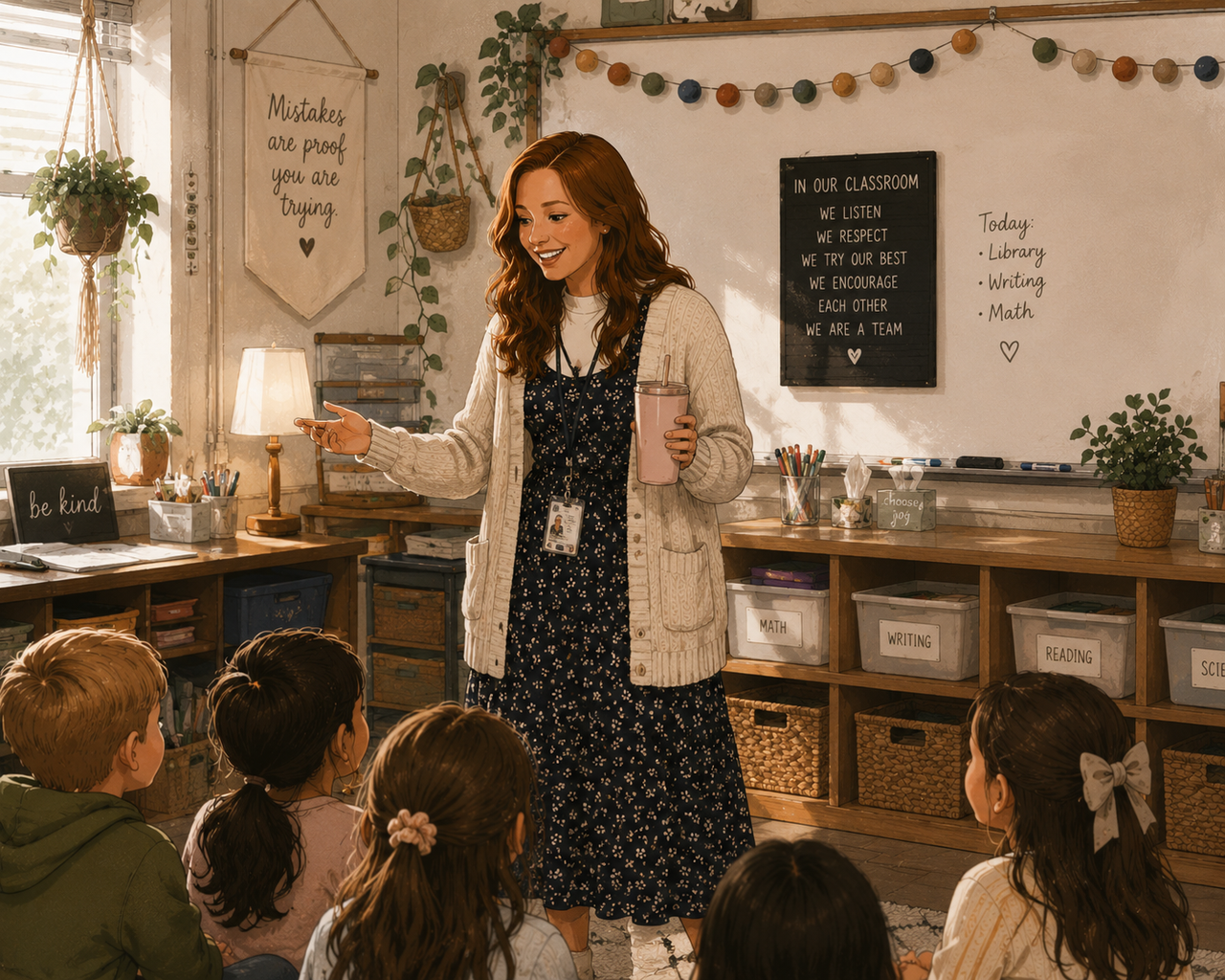
If you're new to teaching, let me let you in on a little secret: teaching is hard.
There is a LOT expected of teachers, and the first few years come with a steep learning curve. My ideal picture of what life as a teacher would look like fell apart almost immediately. Things didn't go the way I had imagined, and everything felt much more difficult than I expected.
Like many new teachers, I often felt overwhelmed, exhausted, and unsure of myself. There were days when I regretted becoming a teacher because I constantly felt like I was falling short or letting people down. I would burn out quickly, yet there was always more to learn and more to do.
The reality is that teacher burnout is incredibly common. The demands of the job can be so overwhelming that we lose sight of what is truly important. We put our heads down, switch into survival mode, and focus on simply making it through the year.
I know that I have a heart for teaching, but there have been many moments when I felt stuck in a lose-lose situation. Public education is facing real challenges right now, and many teachers are carrying more responsibility than ever before.
Over the years, I have learned a few things that help me protect my energy, improve my work-life balance, and find more joy in teaching. These are the strategies that help me avoid teacher burnout and continue showing up for my students in a healthy and sustainable way.
In this article, I'll share the 10 strategies that have helped me avoid teacher burnout and find more joy in the classroom:
Before we dive in, I want to be clear: I don't do all of these things perfectly. Some weeks are better than others. These are simply the habits that have helped me stay in a profession that I genuinely love.
How productive are you anyways when you are trying to work at lunch? Normally, I am tired and grumpy and the kids are eating their lunches in my classroom. I always go to the breakroom and try to be friendly. Hopefully you have a good staff at your school and can make some good friendships. I know that teachers can be really cliquey, but if there are some good human beings on your team, make an effort to get to know them and build some friendships. Something I really appreciate about my school is that I feel comfortable to let anyone of my staff members know if I am having a bad day or dealing with something tough. It's also fun to take some time to laugh at the silly things your kids do. It's important to remember that it takes time to build relationships and feel comfortable talking to people. I don't really enjoy getting to know new people, but I really rely on my coworkers for support during the day so I would say that it is worth being a little bit uncomfortable at the beginning.
Perhaps you are more the kind of person that needs some alone time in order to recharge. There is nothing wrong with eating your lunch in your car or going for a walk by yourself. Teaching takes a LOT out of you. It's noisy and the kids need you all the time. It's important to take some time for yourself so that you have something to give the kids in the afternoon. You don't need to explain to anyone why you're not in the break room. Ideally, you can let your staff members know that you are taking a walk by yourself because you're all peopled out. If they care about you, then they will know that they have not done something to offend you.
During my first two years of teaching, I felt a lot of pressure to prove myself. I was insecure, and I didn't handle criticism or advice from other teachers very well. Even when their suggestions were helpful, I often took them personally because they made me feel small.
The truth is, I had no idea what I was doing—and that's completely normal for a new teacher.
As much as it sometimes hurt to hear, many of those teachers were trying to help me. Looking back, some of the best professional growth I experienced came from listening to people who had more experience than I did.
Over time, you will develop your own teaching style. You'll learn what works for you, what doesn't, and which advice is worth taking. One of the most important new teacher tips I can offer is this: be humble enough to learn from others, but confident enough to trust yourself.
As a teacher, there will always be people who question your decisions. Sometimes it will be another teacher. Sometimes it will be a parent. Occasionally, it might even be your administrator.
Listen to what they have to say. There may be something valuable you can learn from their perspective. However, don't let every comment steal your peace or keep you awake at night.
Remind yourself that no one else fully understands what happens in your classroom every day. Most people only see a small piece of the picture.
That being said, if there is a grain of truth in someone's criticism, try to separate it from the emotions surrounding it. Growth often comes from being willing to reflect on our mistakes without allowing them to define us.
Learning to accept feedback without constantly questioning your worth is an important part of avoiding teacher burnout. You don't need to be a perfect teacher. You just need to keep learning.
My first year as a teacher, I left the school most days before 4. There are people who will tell you that you need to be at the school every night till seven after graduating college. You have every right to just ignore them when people say that to you. You are not getting paid for that time, so you should only be staying late if that is going to give you peace of mind about the next day. As well, if you are planning your routines properly, you really do not need to be staying late every night. During your first year as a teacher, there's a lot of things that you may want to do, but you really should not be doing. Making beautiful master plans is something that you should really be leaving until your second or third year of teaching a grade. Besides, you are still learning, and what if you decide you want to completely change your plans after learning something new at a conference. You should not be planning too far in advanced, or too many details.
My evenings were usually about recovery when I got home after my first and my second year of teaching. I needed to be alone in my bedroom and take a powernap. I would either make dinner or my handsome husband would. I needed to tell him everything about my day, maybe get a walk in, maybe have a bath and that was about it. I really did not do a lot of socializing as I really needed the down time to recover and re-charge for the next week of school.
One of the biggest lessons I learned during my first few years of teaching was that every minute you spend teaching a routine will save you hours later in the year.
At the beginning of my career, I thought I needed exciting lessons to keep my students engaged. What I actually needed were predictable routines.
When students know exactly what to do, they ask fewer questions, transition more smoothly, become more independent, and require far less redirection throughout the day. That means less decision fatigue for you and more energy to spend on actually teaching.
One routine completely transformed my classroom: our morning routine.
Instead of trying to settle twenty excited kindergarten students while taking attendance, answering questions, and preparing for the day, my students came in knowing exactly what to do. They practiced important literacy and math skills independently while I had a chance to greet students, connect with families, and prepare for the day ahead.
It didn't just make my mornings calmer—it changed the entire tone of our classroom.
If you're looking for a simple way to reduce stress and create more independence in your classroom, I've shared the exact editable morning routine I use with my own students in my Teachers Pay Teachers store.
👉 Take a look at the Kindergarten Morning Routine here.
The more your classroom runs on routines instead of reminders, the less exhausted you'll feel by the end of the day.
There are certain parts of teaching that simply need to get done, whether we enjoy them or not. Report cards need to be written. Assessments need to be completed. Routines need to be followed.
However, if you want to avoid teacher burnout, it is important to make time for the parts of teaching that bring you joy.
For me, that's art.
Nothing makes me happier than working on an art project with my students. Yes, it's messy. Yes, there are supplies to clean up afterward. But there is something so rewarding about watching children create, experiment, and take pride in their work.
Sometimes, when I'm going through something difficult in my personal life and the thought of teaching feels especially heavy, I'll change our plans and make space for an art project. (Of course, not the week before report cards are due!)
There is something about our little art rituals that reminds me why I became a teacher in the first place.
Maybe art isn't your thing.
Perhaps you love reading novels with your class. Maybe you enjoy teaching science experiments, taking students outside, or sharing a topic that you're passionate about. It might not even be something that's explicitly written in the curriculum.
One of the beautiful things about teaching is that we get to share pieces of ourselves with our students.
When students see that you are genuinely excited about something, they respond differently. They notice your enthusiasm. Students who are usually disengaged may suddenly lean in and participate. Lessons feel less like work and more like a shared experience.
In my experience, passion is contagious.
If you love learning, your students are more likely to love learning. If you love school, your students are more likely to love school too.
When teaching starts to feel overwhelming, try to make room for something that reminds you why you wanted to become a teacher in the first place.
This is one of my favorite teacher tips, and it has made a huge difference in my classroom.
Every September and October, I make an effort to send at least one positive email home for each student in my class. It takes some time, but it is one of the best investments I make all year. It doesn't have to be long either. Just three sentences saying that you noticed a student did something you appreciated in class.
There are several reasons why I do this.
First, it helps build positive relationships with students. When students hear that you have shared something kind about them with their parents, they feel seen and valued. They begin to believe that you genuinely like them, and that positive relationship often carries over into the classroom.
Second, it helps build trust with parents. Most parents are used to hearing from the school when there is a problem. Imagine how refreshing it is to open your inbox and read that your child did something thoughtful, worked hard, or showed kindness to a classmate.
Those positive interactions create a strong foundation for future communication.
As teachers, there will inevitably be times when we need to have difficult conversations with families. Maybe a student is struggling academically. Maybe there are behavior concerns that need to be addressed.
When parents have already received positive communication from you, those conversations tend to go much more smoothly. They know that you see the whole child—not just the challenges.
One thing I have learned over the years is that it is especially important to send positive emails home for students who are challenging you.
There has to be something positive you can say about every child.
Maybe they were kind to a classmate. Maybe they worked hard on an assignment. Maybe they had one really great day after several difficult ones.
If you are frequently contacting a family about concerns, it becomes even more important to recognize and communicate the positive moments too. Otherwise, families can begin to feel discouraged or defensive every time they hear from the school.
Positive parent communication is one of the simplest ways to improve classroom relationships, strengthen classroom management, and create a more supportive learning environment for everyone involved.
One of the simplest ways to improve classroom management is to intentionally notice and celebrate positive behavior.
Sometimes it is something as small as thanking a student for helping clean up the classroom—especially when I didn't even have to ask.
I remember one parent telling me during a parent-teacher conference that her daughter talked about my compliment for days. I honestly didn't even remember saying it, but it meant the world to that student.
Moments like that remind me how much our words matter.
Students love encouragement. Whether it's a sticker, a note home, a quick compliment, or public praise, most children thrive when they feel noticed and appreciated.
One of my favorite strategies is to compliment a student while the rest of the class is listening.
Instead of simply saying, "Good job," I'll be very specific.
"I love how carefully you colored that picture."
"Thank you for helping your classmate without being asked."
"You added so much detail to your writing."
When I do this, something interesting usually happens. Other students start copying that behavior because they want to receive positive feedback too.
It's a simple strategy, but it can have a huge impact on classroom culture.
I especially try to focus on positive reinforcement during seasons when I feel like I am constantly correcting behavior. Students get tired of hearing us nag, and honestly, I get tired of hearing myself nag too.
Sometimes the entire classroom needs a reset.
Making an intentional effort to notice what students are doing well can shift the atmosphere of your classroom surprisingly quickly. Not only does it encourage positive behavior, but it also helps create a classroom environment where students feel valued, capable, and motivated to do their best.
One of the biggest mistakes I made as a new teacher was thinking that I needed to figure everything out by myself.
The truth is that teaching is a team sport.
If you have the opportunity to work alongside another teacher, take it. Even if their teaching style is completely different from yours, there is always something to learn from the people around you.
Over the years, I have learned that every teacher has something valuable to offer. Some have incredible classroom management skills. Others are amazing planners. Some are gifted at building relationships with students. No matter how experienced you are, there is always more to learn.
You do not need to reinvent the wheel during your first few years of teaching.
Borrow ideas. Ask questions. Share resources. Observe other teachers if you have the opportunity. Most educators are happy to help because they remember what it felt like to be new.
It is also important to ask parents for help when you are struggling to understand a student.
Whenever possible, I try to assume that parents want to work with me, not against me. They know their child better than anyone else and can often provide valuable insight into what works at home.
Sometimes when I reach out about a student's difficult week, parents share information that completely changes my perspective. Maybe there has been a major life change at home. Maybe the family is going through a challenging season. At the very least, those conversations help me approach students with more empathy and understanding.
One of the hardest parts of teaching is that we care so deeply about our students.
We carry their struggles with us. We worry about them. We celebrate their successes and feel heartbroken when they are hurting.
I remember many days when I felt defeated before lunchtime. I was so aware of all the needs in my classroom and often felt inadequate to meet them. How was I supposed to support twenty students emotionally while also teaching them how to read, write, and solve math problems?
The reality is that no teacher can meet every need.
As much as we love our students, we are not their parents, therapists, psychologists, or social workers. We can support them, care for them, and advocate for them, but we cannot carry the weight of every problem on our shoulders. There were students who I knew needed a little extra attention or a few extra minutes of conversation in the morning. While I couldn't solve every problem in their lives, I could make sure they felt seen and cared for while they were with me.
That is why emotional support is so important.
For me, that often meant calling my mom during my lunch break, talking through difficult situations with coworkers, or leaning on my husband after a hard day. Some of my greatest sources of support have been the educational assistants, teachers, and friends who reminded me that I was not carrying these challenges alone.
Sometimes taking care of yourself also means saying no.
You do not need to volunteer for every committee, organize every school event, or take on every extra responsibility that comes your way.
Teaching is already a demanding job.
If you want to avoid teacher burnout, make sure you are allowing other people to support you too.
One of the most important lessons I have learned as a teacher is that not everything deserves the same amount of your energy.
When you're a new teacher, it can feel like everything is important. You want the perfect classroom. The perfect lesson plans. The perfect bulletin boards. The perfect activities.
The problem is that trying to do everything perfectly is one of the fastest ways to burn yourself out.
At the end of the day, your students do not need a Pinterest-perfect classroom.
They need a teacher who is present, patient, and emotionally available.
You are also not going to cover every single outcome in the curriculum perfectly. No teacher does.
In fact, sometimes our obsession with the small details distracts us from the things that matter most.
Your students need to feel safe.
They need to learn how to read, write, and solve basic math problems.
They need opportunities to build friendships, learn responsibility, and become kind, thoughtful members of their community.
Those are the things they will carry with them long after they leave your classroom.
Whenever I start feeling overwhelmed, I try to remind myself of my priorities.
If my students are safe, loved, learning, and growing, then we are doing okay.
Don't let the little things steal your energy from the things that matter most.
Now, I realize this advice might sound a little contradictory after the last section.
A few minutes ago, I told you not to worry about having a Pinterest-perfect classroom. I still stand by that.
However, if creating a beautiful space brings you joy, then I think it is worth putting some effort into.
For me, my environment matters.
I like to think I have an artistic eye, so I notice when my classroom feels cluttered or chaotic. I like things to feel organized, peaceful, and inviting. I enjoy having framed photos of my family in my classroom, a few plants on my desk, and displays that showcase my students' work. Those little touches make the space feel more personal and make long days at school a little more enjoyable.
One of the realities of teaching is that we spend a huge portion of our lives in our classrooms.
If there are small things you can do to make that space feel more welcoming, why not?
The key is to decorate because it brings you joy—not because you feel pressure to impress other teachers on Pinterest.
Over the years, I have learned that there is a big difference between creating a classroom that feels good to work in and chasing perfection.
One fills your cup.
The other drains it.
If organizing, decorating, and creating beautiful spaces gives you energy, then I encourage you to make time for it. Just remember to keep your priorities in the right order.
And one final piece of advice: if you have decorations, plants, or personal items that are especially precious to you, put them somewhere high up.
Trust me on that one.
One of my favorite things about teaching is the relationships I build with my students.
When life gets busy and your to-do list feels endless, it can be easy to forget that the children in front of you are the reason you became a teacher in the first place.
I know what you're thinking: "That sounds great, but I don't have time for that."
The truth is, you might need to make time.
Building relationships with students does not always require elaborate activities or extra planning. Sometimes it looks like joining a group of students on the carpet during free time and helping them build a Lego spaceship. Sometimes it means asking questions about their weekend, their soccer game, or the book they're reading.
Those small moments matter.
In fact, I have often found that strong relationships improve classroom management more effectively than almost anything else. Students are more likely to listen to teachers they trust and feel connected to.
One of my favorite things to do is laugh with my students.
Every class seems to have at least one student who keeps everyone entertained. Instead of always rushing to the next task, I try to make space for those moments of joy. Some of my favorite classroom memories have come from unexpected conversations, funny comments, and the unique personalities that students bring into the room every day.
As teachers, we spend so much time thinking about lesson plans, assessments, behavior management, and curriculum outcomes that we sometimes forget to enjoy the people we are teaching.
Don't let your to-do list become more important than your students.
Give yourself permission to slow down occasionally. Laugh with your class. Listen to their stories. Build the Lego spaceship.
Those moments are often the ones your students will remember most.
And if we're being honest, they're often the moments you'll remember too.
Teaching is one of the most rewarding jobs in the world, but it is also one of the most demanding.
If you're feeling overwhelmed, exhausted, or stretched too thin, it doesn't mean you're failing. In many ways, it means you're carrying the weight of a job that matters deeply.
Give yourself permission to be a learner. Protect your energy. Ask for help. Focus on what matters most.
Your students do not need a perfect teacher.
They need a healthy one.
Join the letter and I’ll send the Morning Routine Printables to your inbox.
No spam, ever. Unsubscribe anytime.